
Trekking and Outdoor Adventures: The Saint Vicinius Way Between Emilia-Romagna and Tuscany
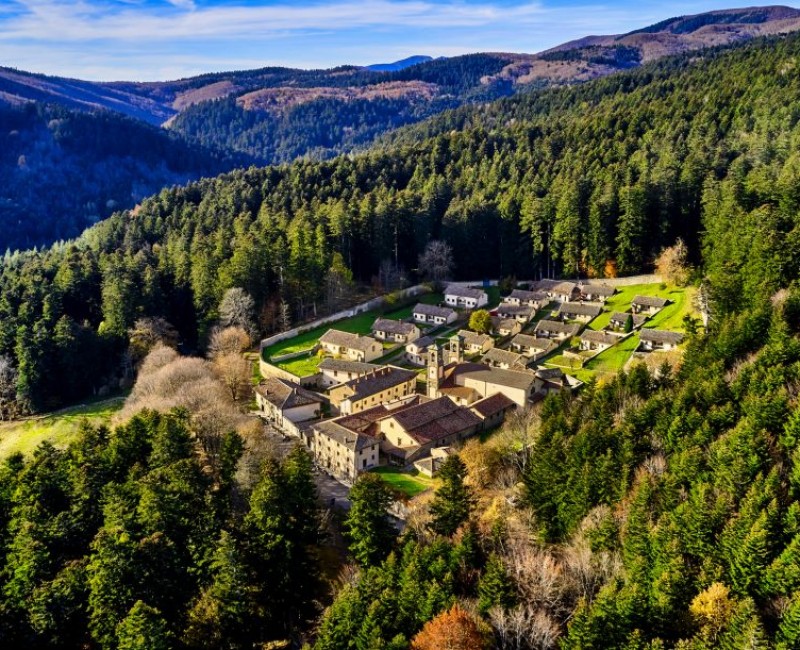
Saint Vicinius, it must be said, knew a trick or two when it came to dealing with the devil. With his legendary magical collar, he drove away demons and brought comfort to those in need. Following in the footsteps of the ancient Bishop of Sarsina, we explore historic routes through monasteries and medieval fortresses.
Where Is the Saint Vicinius Way?
The Saint Vicinius Way is a multi-stage walking route, with detours and alternative paths, stretching for approximately 250 kilometres. Most of the route lies in Romagna, with a short section crossing into Tuscany.
The route passes through two protected areas: the Casentinesi Forests National Park and the Nazzano, Tevere-Farfa Regional Nature Reserve.
The route begins and ends in Sarsina, in the province of Forlì-Cesena.
It follows the ancient road network of the Provincia Alpes Appenninae, which for centuries connected the peoples of Northern Europe with the capital of Christianity.
This network of roads linked the area’s most important sanctuaries and provided access to many others through short detours from the main routes.
As with other religious pilgrimage routes, walkers can obtain a certificate documenting their journey, with stamps collected along the way.
Why Is It Called the Saint Vicinius Way?
The route draws inspiration from the life of Vicinius, Bishop of Sarsina from AD 303 to 330, and connects some of the most important medieval religious centres.
Blending history and legend, faith and tradition, the route revolves around the ancient episcopal seat and retraces some of the most significant places associated with the religious and monastic heritage of what is now Emilia-Romagna.
It passes through several places that once formed part of ancient pilgrimage routes, both along the main roads used by pilgrims travelling to Rome and along their secondary branches.
Numerous religious buildings, sanctuaries and churches were established near the principal pilgrimage routes, often becoming destinations just as important as the villages along the main roads.
The Way therefore follows in the footsteps of the Bishop who made Sarsina one of the best-known destinations for pilgrims. Countless legends and traditions grew around him and his cathedral.
The Landscapes and Villages Along the Way
Sarsina: The Magic of a Thousand-Year-Old Town
Sarsina is both the starting and finishing point of the Way, as well as its symbolic heart. It was here that Vicinius served as Bishop, in what was once the most important religious and civic centre in the area.
It is therefore only natural that the heart of Sarsina should be the Cathedral of Santa Maria Annunziata, Sanctuary of Saint Vicinius. Dating back to the Byzantine period, it is one of the most important examples of Romanesque architecture in Italy.
The memory of the saint is everywhere. At the end of the right-hand nave stands the chapel dedicated to him, built in 1755 at the initiative of Bishop Paolo Calbetti.
This is the cathedral’s most sacred place: his relics are preserved beneath the altar, while his collar is kept in the tabernacle.
The collar of Saint Vicinius has long held a special place in the religious traditions of the area. Vicinius was believed to use it for its healing powers and, above all, for exorcisms.
Even today, the faithful are invited to kiss the collar. The saint also appears in the altarpiece depicting the Madonna and Child with the crowned Saint Vicinius, painted by Ippolito Scarsella, known as Scarsellino.
Saint Vicinius also appears in the votive paintings along the walls, created by Michele Valbonesi between 1755 and 1760. Based on a twelfth-century lectionary, they illustrate the most important episodes in the Bishop’s life.
Just outside Sarsina, an even older story is told by the so-called Mausoleum of Obulaccus, a funerary monument from the necropolis of Pian di Bezzo, erected in memory of Aulus Murcius Obulaccus and dating back to the first century AD.
Ancient legends sometimes echo in the names of villages. One example is Verghereto, a small village near Sarsina, whose name is said to derive from the rods used by the monks of the Abbey of St Michael the Archangel to drive away St Romuald, who had attempted to impose the strict rules of the Camaldolese order.
Sant’Agata Feltria: The Spirit of the Middle Ages
From village to village, nature accompanies travellers along the Saint Vicinius Way. Forests, rocky cliffs and great boulders mark the route from Balze towards the Hermitage of Sant’Alberico, whose origins date back to the eleventh century, before reaching Sant’Agata Feltria, a village rich in history and monuments.
Rocca Fregoso, built by the Malatesta family in the fourteenth century and later adapted by the Montefeltro family, gradually evolved from a defensive fortress into a noble residence under the Fregoso family.
The Angelo Mariani Theatre is a small architectural masterpiece and the oldest surviving example in Italy of a theatre built entirely from wood. The original stage and auditorium remain, further embellished in the eighteenth century with balconies.
Also worth visiting are the Baroque Church of San Francesco delle Rose, with its pews decorated with the coats of arms of noble families and an original sixteenth-century holy water font, and the tenth-century Collegiate Church of Sant’Agata.
But the wonders do not end there. Just outside the village stands the sixteenth-century Sanctuary of the Madonna of the Capuchin Friars, which houses Angeloni’s 1786 painting of the Immaculate Conception.
Not far away, in Collina, visitors can cross the Roman bridge that once provided the only connection between Romagna and Montefeltro.
Sogliano al Rubicone: Ancient and Modern Art
The Middle Ages and Renaissance come to life again in Sogliano al Rubicone, a village perched on a rocky outcrop between the valleys of the Rubicone and Uso streams. The small village preserves the seventeenth-century Church of the Suffragio, famous for its gilded wooden altar and the 1575 painting of the Madonna delle Vigne.
Equally unusual and fascinating is the Museum of Arte Povera, with its collections of almanacs, recipes, advertisements, postcards and religious images.
Finally, do not miss what has become the modern symbol of the village: Tonino Guerra’s Butterfly Fountain, together with the Christa Line Museum, which commemorates the tragic events of the Second World War in this corner of Romagna.
Many small treasures can also be found in nearby Monteleone, a village awarded the Orange Flag by the Italian Touring Club, whose castle once hosted the poet Lord Byron.
Sorrivoli: In Caesar’s Footsteps
Also overlooking the Rubicone is Sorrivoli, a hamlet of Roncofreddo. Built around its castle, once accessible only by drawbridge, the village offers a unique panorama of the valley from the terrace within the castle courtyard.
Walking within its walls feels like stepping back into the Middle Ages, among historic buildings and the village’s religious landmark, the Church of Saints Lorenzo and Aldebrando.
Just outside the village, historic churches and settlements follow one another: Calisese, traditionally believed to be the place where Caesar decided to declare war on the Roman Senate; the valley of the Marano stream; and the Abbey of Santa Maria del Monte, a traditional destination for votive offerings since at least the fourteenth century.
Cesena is the largest urban centre along the Way, with its open-air museum of cast-iron street furniture, the Bonci Theatre, the Cathedral of San Giovanni Battista and the extraordinary fifteenth-century Malatestiana Library, which has been exceptionally well preserved.
La Verna and Camaldoli: The Spirituality of the Forest
The route also visits two places that symbolise monastic life and spirituality. The Hermitage of Camaldoli is the mother house of the Camaldolese Benedictine order, founded by Saint Romuald in 1024.
Its extensive stone buildings are arranged around the main complex, which houses the guest accommodation, library and historic pharmacy. A beautiful fountain bearing the Camaldolese symbol of two joined doves has stood guard over the entrance for centuries.
The Sanctuary of La Verna, meanwhile, is one of the most important spiritual sites associated with the Franciscan tradition, nestled in the heart of the Casentinesi Forests.
When to Go
The route is at its best from March to October.
Every season has its own beauty: spring brings colourful blossoms, while autumn transforms the forests into a spectacular display of unforgettable colours.
In summer, the many woodland sections offer welcome shelter from the heat.
How to Plan Your Journey
With the exception of the Cesena stage, all the other stages begin and end in small, picturesque villages with limited accommodation.
It is therefore advisable to book accommodation well in advance, especially if you plan to complete several stages or walk the entire route.
Some sanctuaries and monasteries also offer accommodation to pilgrims and visitors, including Camaldoli and La Verna.


Leave a Reply
Want to join the discussion?Feel free to contribute!